


Insights • Innovation • Value
Orthopaedic Insights & Industry Blog
Exploring Value-Based Healthcare & Clinical Progress
2026 Top External Fixation Systems Types for Global Buyers
Choosing the right External Fixation Systems requires more than comparing frame shapes or catalogue prices. Global buyers must examine clinical purpose, bone stability, soft-tissue condition, surgeon experience, and available after-sales support. A system used for complex fractures may not suit limb lengthening, deformity correction, or temporary damage-control procedures. Small differences matter, including pin coatings, clamp adjustment, radiolucency, frame weight, and instrument compatibility.
Gavriil Ilizarov, the orthopedic surgeon who developed the circular fixation method, stated, “The tension-stress effect is the stimulation of regenerative and growth processes in tissues.” His principle still influences modern fixation design. It reminds buyers that mechanical stability must work with biological healing, not against it. Evidence, training, and careful patient selection remain essential.
This 2026 guide reviews major External Fixation Systems types for international purchasers, including unilateral frames, circular systems, hybrid frames, and hexapod solutions. It considers practical factors such as material quality, sterilization processes, modularity, documentation, and regulatory expectations. Manufacturers may present impressive technical data. Yet real-world performance can vary with application, anatomy, and operating-room conditions. That limitation deserves attention.
A lower purchase price is not always a lower total cost. Replacement pins, compatible tools, training, shipping delays, and clinical complications can change the calculation. Buyers should request traceable product information and verify local compliance before procurement. No single system is ideal for every hospital. Better decisions come from matching proven design with actual clinical needs.
What External Fixation Systems Are and How They Work
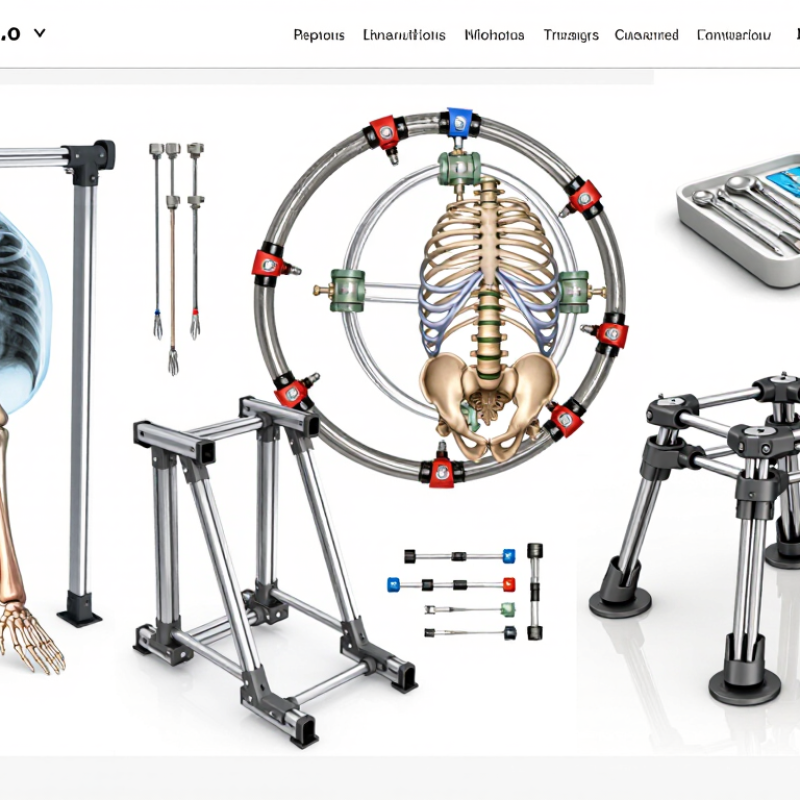
External fixation systems stabilize fractured bones from outside the body. Surgeons place metal pins or tensioned wires through healthy bone. Clamps connect these elements to external rods or rings. The frame holds alignment while damaged tissues recover. It can also provide controlled compression, distraction, or gradual correction. Common designs include unilateral, bilateral, circular, and hybrid frames.
The need remains significant. The World Health Organization’s Global Status Report on Road Safety 2023 estimated 1.19 million road traffic deaths annually. Many survivors sustain complex limb injuries. External fixation can support rapid stabilization, especially when swelling, contamination, or soft-tissue damage limits internal surgery. It also allows wound access and repeated dressing changes. However, it is not automatically the best answer. Pin-site infection, loosening, joint stiffness, and patient discomfort require active management.
Tips: Buyers should match the frame to fracture location, bone quality, soft-tissue condition, and surgeon experience. Confirm radiolucent components, adjustable clamps, pin-size options, and documented sterilization compatibility. Training matters. A technically advanced frame may perform poorly without reliable application and follow-up. The AO Surgery Reference emphasizes planning, safe pin corridors, and progressive postoperative assessment. In practice, real cases are less tidy than diagrams. Procurement teams should review failure reports, repair availability, and clinical feedback before selecting a system.
Core Types of External Fixation Systems in 2026
External fixation systems stabilize fractures without placing all hardware inside the injured area. Their main types include unilateral frames, circular frames, hybrid frames, and rail-based systems. Each design serves a different mechanical and clinical purpose.
Unilateral frames use rods and pins on one side of the limb. They are practical for rapid stabilization and temporary treatment, especially when swelling or open wounds limit internal procedures. Circular frames distribute support around the limb and allow precise alignment adjustments. They can support complex fractures, deformity correction, and gradual bone lengthening. Hybrid frames combine rings with half-pins, offering useful flexibility around joints and damaged soft tissue. Rail systems provide adjustable axial support and can simplify staged treatment. Yet, they may not suit every fracture pattern.
Tips: Match frame geometry with fracture location, soft-tissue condition, and expected treatment duration. Check pin-site access, radiolucent components, adjustment range, and instrument compatibility before purchase. Teams should also review sterilization instructions, training requirements, and local medical-device regulations. Small details matter.
From a buyer’s perspective, the strongest system is not always the most complex. Lightweight construction can improve handling, while rigid connections support alignment under load. Clinical teams should assess imaging visibility and patient mobility during real-world use. Evidence, surgeon experience, and documented quality controls should guide selection. A careful evaluation may reveal that one versatile system still needs additional modules for difficult cases.
2026 Top External Fixation Systems Types for Global Buyers
Core Types of External Fixation Systems in 2026
How to read this chart: The values represent the representative number of independent correction axes supported by each frame concept, rather than market share or sales volume.
- Monolateral systems: Commonly used for temporary stabilization, open fractures, and straightforward unilateral fixation.
- Circular ring systems: Provide multiplanar fixation and are widely applied in complex fractures, bone defects, and deformity correction.
- Hybrid systems: Combine ring components with half-pins to balance multiplanar stability with easier application in selected bone segments.
- Hexapod systems: Use six adjustable struts for computer-assisted, multiplanar deformity correction and gradual alignment changes.
Key Components and Frame Configurations
External fixation systems in 2026 are selected by anatomy, injury pattern, and treatment goals.
Their performance depends on more than metal strength. Each component must work as part of a stable, adjustable structure.
Key components include half-pins, tensioned wires, rods, rings, clamps, hinges, and connecting struts.
Half-pins provide direct bone support through selected corridors. Wires can improve fixation around complex or small bone segments. Clamps control pin position and frame stiffness. Rods create simple linear frames, while rings distribute forces around a limb. Fit matters more. A poorly positioned clamp may limit movement or complicate wound care.
Frame configuration changes the system’s behavior.
Unilateral frames are practical for rapid stabilization and easier access to soft tissues. Bilateral frames offer support from opposite sides but may increase bulk. Circular frames provide multiplanar control and can support gradual correction. Hybrid frames combine rings with half-pins when anatomy or patient comfort demands flexibility. Hinged frames may assist controlled joint movement, but alignment must be checked repeatedly.
Global buyers should examine material traceability, instrument compatibility, pin and wire size ranges, sterilization instructions, and documented mechanical testing.
Clear assembly guides reduce avoidable errors across different clinical teams. That detail matters.
In practice, the strongest frame is not always the best frame. It may obstruct dressing changes, press against sensitive skin, or discourage patient mobility. Even experienced teams should reassess the configuration after swelling changes, because the original plan can become less suitable.
Clinical Uses, Benefits, and Limitations
2026 Top External Fixation Systems Types for Global Buyers
Clinical Uses, Benefits, and Limitations
External fixation remains valuable when swelling, open wounds, or unstable fractures make internal fixation unsuitable. Common systems include unilateral frames, circular frames, hybrid frames, and modular rail systems. Unilateral frames are practical for temporary stabilization and straightforward limb alignment. Circular frames can support complex deformities, bone loss, and gradual correction. Hybrid designs may help when bone segments require different fixation strategies.
The main benefit is rapid stabilization with limited surgical exposure. Clinicians can inspect wounds, manage soft tissues, and adjust alignment after surgery. External frames also support staged treatment when a patient needs further medical optimization. However, they are not simple devices. Pin-site infection, loosening, nerve injury, joint stiffness, and frame discomfort remain important concerns. Patient mobility may become difficult, especially with bulky constructs. A technically strong frame can still fail if follow-up care is weak. No system is universally superior.
Tips: Buyers should match the frame to fracture location, soft-tissue condition, correction needs, and local surgical skills. Check pin compatibility, radiolucency, adjustment range, sterilization requirements, and documentation before purchase. Training matters. So does service support. Ask for verified mechanical data and clinical instructions, not only marketing claims. In resource-limited settings, simpler systems may be more reliable than highly adjustable designs. That is an uncomfortable trade-off, but it deserves honest discussion. Pricing alone can mislead. Stock availability, replacement parts, and surgeon experience often influence real clinical value.
How Global Buyers Evaluate and Select a System
2026 Top External Fixation Systems Types for Global Buyers
Global buyers now compare more than ring, rail, and hybrid configurations. They examine fracture patterns, soft-tissue access, transport conditions, and surgeon training. The WHO Global Status Report on Road Safety 2023 records approximately 1.19 million annual road-traffic deaths. This figure signals a continuing need for adaptable trauma systems, especially where operating rooms and imaging equipment are limited. A useful system should allow rapid application, stable fixation, and practical adjustments beside the patient’s bed.
Selection should begin with clinical use cases, not catalogue photographs. Review pin diameter options, clamp locking strength, radiolucency, sterilization methods, and instrument compatibility. Check published mechanical testing and biocompatibility evidence. ISO 14971 supports structured medical-device risk management, while ISO 13485 addresses quality-management controls. Buyers should also request training records, failure data, replacement-part availability, and service response times. A cheaper frame may become expensive when one missing clamp delays treatment. That assumption deserves testing.
Tips: Ask for a complete trial set. Measure assembly time with gloved hands. Inspect clamps after repeated sterilization cycles. Compare local inventory, not promised delivery dates. Require transparent documentation from the supplier. WHO data describes a global burden, but it does not predict every hospital’s needs. Local fracture patterns, staffing, and referral distances still matter. A technically excellent system may fail operationally when training is too brief.
2026 Top External Fixation Systems Types for Global Buyers - How Global Buyers Evaluate and Select a System
| System type | Typical clinical applications | Frame configuration and mechanical characteristics | Typical fixation elements | Adjustability | Main advantages | Main limitations | Global buyer evaluation priorities |
|---|---|---|---|---|---|---|---|
| Unilateral / monolateral fixator | Temporary stabilization of open fractures, damage-control trauma, and selected definitive treatment of long-bone fractures. | One-sided longitudinal bar with clamps connecting the bone pins. The frame is relatively simple and allows fast application. | Usually threaded Schanz pins, commonly about 4–6 mm in diameter for adult long-bone applications; pediatric sizes are smaller. | Moderate. Pin and clamp positions can often be adjusted, but correction of multiplanar deformity is limited compared with ring frames. | Fast assembly, relatively low component count, straightforward radiographic access, and generally easy nursing access. | Less effective for complex multiplanar deformities, short periarticular segments, and fractures requiring high angular control. | Clamp security, bar stiffness, pin-size range, radiolucency, instrument simplicity, and availability of replacement clamps and pins. |
| Bilateral / biplanar fixator | Unstable tibial or femoral fractures where greater frame stiffness is needed than a single-sided construct can provide. | Bars or rods are positioned on two sides or in two planes, increasing resistance to bending and torsion. | Threaded pins, commonly around 4–6 mm in adults, with clamps capable of holding multiple bars or planes. | Moderate. The frame can be lengthened or reconfigured, but access around the limb may be more restricted. | Higher construct stiffness than a simple unilateral frame and useful when fracture stability is a major concern. | Bulkier profile, more demanding application, and potentially greater interference with wound care, imaging, or patient mobility. | Mechanical stiffness, clamp versatility, clearance from soft tissues, compatibility with imaging, and operating-room assembly time. |
| Circular ring fixator | Complex fractures, periarticular injuries, bone transport, limb lengthening, deformity correction, and cases with limited safe corridors for half-pins. | One or more rings connected by threaded rods or telescopic struts. The circumferential structure provides strong multiplanar control. | Fine tensioned wires commonly about 1.5–2.0 mm, often combined with half-pins of approximately 4–6 mm in adults. | High. Components can support gradual correction, compression, distraction, translation, and controlled lengthening. | Excellent multiplanar stability, flexible wire placement, and strong suitability for deformity correction and bone reconstruction. | Longer planning and application time, a larger external profile, more demanding patient education, and many pin or wire sites. | Ring-size range, wire and pin compatibility, strut accuracy, software or planning support, training requirements, and spare-part availability. |
| Taylor-spatial / hexapod-style frame | Complex post-traumatic deformities, malalignment, nonunion, bone loss, and gradual correction in multiple planes. | Two rings or partial rings connected by six adjustable struts, allowing coordinated correction of translation, angulation, rotation, and length. | Tensioned wires around 1.5–2.0 mm and/or half-pins commonly around 4–6 mm, depending on anatomy and construct design. | Very high. Correction schedules can be calculated and modified during treatment when appropriate clinical and radiographic data are available. | Powerful multiplanar correction, modularity, and the ability to perform gradual adjustments without complete frame replacement. | Higher training burden, dependence on accurate measurements, greater component complexity, and more intensive follow-up. | Strut measurement accuracy, planning workflow, software usability, radiographic documentation, training, and long-term component supply. |
| Hybrid ring fixator | Proximal tibial and distal femoral periarticular fractures where ring support is required near the joint and half-pins are useful in the shaft. | A ring or partial ring is combined with unilateral bars or half-pin modules, balancing periarticular fixation and ease of application. | Tensioned wires commonly about 1.5–2.0 mm near the joint, with shaft half-pins often about 4–6 mm in adults. | Moderate to high. The ring component improves multiplanar control while the bar component simplifies shaft fixation. | Useful around metaphyseal and periarticular regions, with fewer wires than a fully circular frame in many constructs. | Requires careful component matching and may provide less uniform correction capability than a complete circular or hexapod frame. | Ring-to-bar compatibility, wire tensioning tools, pin and wire trajectory options, joint clearance, and conversion flexibility. |
| Spanning joint fixator | Temporary stabilization of severe ankle, knee, or wrist injuries with major swelling, soft-tissue damage, or fracture-dislocation. | A rigid frame bridges the injured joint to maintain length and alignment while allowing soft-tissue recovery before definitive treatment. | Large threaded pins, commonly about 5–6 mm for adult lower-limb temporary constructs, with smaller sizes selected for smaller anatomy. | Low to moderate. It prioritizes rapid stabilization rather than joint motion or detailed deformity correction. | Rapid application, reliable length maintenance, and good access for swelling management and staged surgical planning. | Restricts joint movement and is commonly temporary; pin placement must protect neurovascular structures and future surgical approaches. | Emergency availability, rapid assembly, radiographic access, safe pin corridors, radiolucent components, and compatibility with staged conversion. |
| Articulated elbow or wrist fixator | Selected periarticular injuries where controlled movement is desired after stabilization, particularly around the elbow or wrist. | A hinge is aligned with the anatomical or functional joint axis and connected to fixation elements in adjacent bone segments. | Small- to medium-diameter pins, often approximately 3–5 mm in adults, selected according to bone size and location. | Moderate. The hinge can permit controlled flexion and extension while maintaining overall fracture or ligament stability. | May support earlier controlled motion and help reduce stiffness in carefully selected cases. | Accurate hinge alignment is technically demanding; the system is anatomy-specific and unsuitable for every fracture pattern. | Hinge-axis adjustability, range-of-motion control, pin placement options, joint clearance, radiographic visibility, and clinician training. |
| Mini / hand and foot fixator | Metacarpal, phalangeal, metatarsal, toe, and selected forefoot fractures or reconstruction procedures. | Compact unilateral or small ring assemblies designed for limited bone stock and narrow soft-tissue corridors. | Small threaded pins or wires, frequently about 1.0–3.0 mm depending on the digit, metacarpal, metatarsal, or patient size. | Moderate. Compact clamps and low-profile bars allow positioning changes while preserving access to the hand or foot. | Low profile, suitable for small bones, and generally compatible with detailed soft-tissue inspection. | Limited load capacity, delicate pin placement, and less tolerance for excessive tightening or poor alignment. | Smallest available pin and wire sizes, low-profile clamps, fine adjustment, instrument ergonomics, and sterile accessory options. |
FAQS
It stabilizes fractured bones from outside the body. Pins or tensioned wires enter healthy bone. Clamps connect them to rods or rings. The frame maintains alignment during tissue recovery.
It may help when swelling, open wounds, contamination, or tissue damage complicate internal surgery. Stabilization can happen quickly. The frame also allows wound inspection and dressing changes. It is not always the best option.
Common designs include unilateral, bilateral, circular, hybrid, and modular rail frames. Unilateral frames often support straightforward alignment. Circular frames can assist gradual correction and complex deformities. Hybrid frames combine different fixation approaches.
It requires limited surgical exposure. Clinicians can adjust alignment after surgery. It can support staged treatment while the patient receives further care. Controlled compression or distraction may also be possible.
Pin-site infection, loosening, nerve injury, joint stiffness, and discomfort can occur. Bulky frames may restrict walking or daily activities. Pin sites require regular observation. Problems can change the treatment plan.
Match the frame with fracture location, bone quality, tissue condition, and correction needs. Check adjustable clamps and compatible pin sizes. Confirm radiolucent components and sterilization requirements. Small details matter.
A technically advanced frame may perform poorly when applied incorrectly. Surgeons need safe pin corridors and careful planning. Follow-up should include progressive clinical and imaging assessments. Good hardware cannot replace judgment.
Review mechanical data, clinical instructions, failure reports, and repair availability. Check replacement-part supply and local service support. Stock access matters. Price alone can mislead.
Yes, especially where training, repairs, or replacement parts are limited. Simpler designs may be easier to apply and maintain. Highly adjustable systems can offer more options. They can also create more opportunities for error. This trade-off deserves honest review.
Conclusion
External Fixation Systems are orthopedic devices that stabilize fractured or damaged bones from outside the body. They use pins, wires, rods, clamps, and connecting elements to create a supportive frame while allowing access to soft-tissue injuries and surgical sites. In 2026, major system types include unilateral frames, circular frames, hybrid configurations, and specialized systems for temporary or complex fracture management. Each design offers different levels of stability, flexibility, adjustability, and ease of application.
The article explains how frame configurations and component selection influence clinical performance in trauma care, limb reconstruction, deformity correction, and staged treatment. It also examines benefits such as versatility, minimally invasive fixation, and soft-tissue access, alongside limitations including pin-site care, frame complexity, patient comfort, and treatment duration. For global buyers, important evaluation factors include material quality, structural strength, component compatibility, sterilization options, documentation, training support, regulatory suitability, supply reliability, and total cost. A well-matched system should meet clinical needs while supporting safe, efficient, and consistent use across different healthcare environments.
Blog Tags: